
In early 2023, a worried father composed a personal prayer to guide him in his journey with his gravely ill son, Perry. Here is an excerpt:
Heavenly Father , in this trying time , I come before you with a heavy heart. Perry , my dear child fights a battle against cancer and I stand beside him feeling the weight of my worry and concern .
Lord grant me /. Give Perry the strength to face each day with courage and hope. and guide me to be the father he needs in this journey, Help me hold on to my Irish spirit , to bring laughter and warmth even amidst these struggles.
At first glance, this lovely piece of prose seems like a moving request from a loving father. He wrote it from his heart. Or did he? It was actually “composed” in a matter of minutes “by AI at Perry’s Dad’s request. Is it less meaningful? Will God still hear the prayer?
We are living in rapidly evolving world and the impact of AI us everywhere whether you want it or not. It in banking, retail, advertising, and the arts. And it is growing so quickly and becoming more and more sophisticated, that is often difficult to know what is real anymore. As a matter of fact. what is reality anyway ? I see so much advertised on TV as “innovation”, or “progress” that the line becomes blurred very quickly. Don’t get me wrong. There are many positive applications of AI. Medicine and research being one. As long as we have the proper checks and balance for ethics. But alas. We are not a species known for balance. And as result, we may be headed for trouble.
And so I naturally wondered about the impact of AI on religious practices and values. I searched online and found an article by Dr. Alexander Lozano which contained the lovely Perry’s prayer which I quoted earlier. And some fascinating observations which are worthy of note and reflecting on, especially now and during these troubled times.
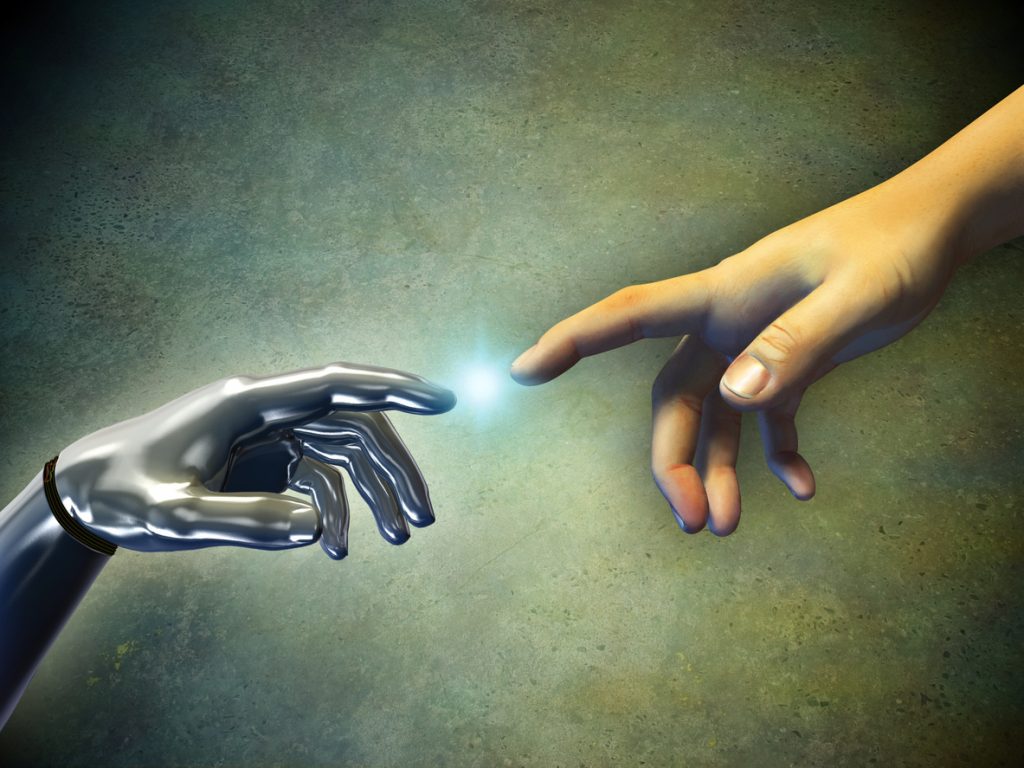
The article, which appeared in a Catholic publication last year , provides some thought provoking points to consider on the intersection of AI and religion which the author describes as a “complex and evolving topic”. There were five main points and I have selected three for us to reflect on.
- Theological implications: Some Christians have wondered whether AI has a soul or conscious ness and what does that tell us about the nature of humanity? For many of us, we use the definition of what is “real” to give us a moral compass to live our lives by. The same is true for Islam and other religions. Do we need to come up with new definitions of what is real (and what is not) or indeed what is “alive”? This would involve redefining the definition of life itself, a daunting task to say the least. We never thought we would be here in our lifetime. Remember when things were so much simpler? Yet ..here we are.
- Religious applications of AI: Aside from members of the clergy using AI to help write their sermons, which I am sure is already happening, apparently some organizations are using AI to develop chatbots to answer spiritual or existential questions. What? I sometimes think that the world has gone mad. Am we now taking advice on the meaning of life from what essentially is a robot? Or is it more that that??
- Existential Questions: The rapid advancement of AI has raised questions about our future and our place in the Universe. Why are we here and what is our purpose? The article tells us that some religious thinkers have reflected on how AI fits into into their beliefs about creation, purpose and identity. And it certainly does that. How do we feel about new forms of intelligence and what does that tell us about ourselves and how we should interact with each other? Especially when we may have different ideas about what is “real” or indeed, what is “alive”. Where will we take our cues?
I don’t have the answers to these BIG questions. I don’t think anyone does and I suspect that attitudes will be somewhat generational. Most of the fears and anxieties that I hear expressed are from my friends and peers who are from the same generation as myself and won’t be around long enough to see the full impact of AI on religion and society in general. ( at least, I hope not ) But it is already becoming pervasive in our new world order. Here in Canada, we already have a Minister of Artificial Intelligence and big companies have whole departments dedicated to it. And some of it, does good things and saves people time and money. But can we reap the benefits without losing our soul in the process? My grandkids are so called digital natives and will grow up in a world where AI is part of every day life. What will life be like for them?
The article concludes by stating that the relationship between AI is multifaceted and and continues to evolve as both technology and religious practices develop. We must discuss the role of AI in shaping human societies and culture. The world is changing.
By the way and for the record, this article was written without the assistance of ChatGPT or AI.
What are your thoughts?
M.A.N.

In response to your article on ‘religion and AI’, I have to say that I am not a formally religious person. But like most thinking people, I am concerned about the growing influence of AI. As you say, we older folk will not be around too much longer. Thus our concern is mostly for ‘our children and beyond’.
Personally, my notion of ‘god’ is a belief in community. It is a recognition and idealization of our best human values — those qualities which make us forces for good. Religion, from my experience and point of view, often divides rather than unites people. Historically and currently we should acknowledge how it has dramatically subjugated, violated, and victimized people.
Yet… within religion we can also see community values which can rise above its individual limitations and differences. Hopefully, that is what we are witnessing in the most recent meeting of King Charles and Pope Leo.
Besides religion, we should be able to look to our democratically elected governments as a powerful influence against what we fear lurks behind and within AI. However… a government of the people demands that we are active in some way to have our government actually represent human values.
In conclusion, it is really up to us individually, and within whatever collective we see ourselves, to evaluate and direct the positive aspects of AI — and to reject what we see as negative.
I cannot disagree that historically , religion has divided us more often than not. I don’t know but my hope is that a healthy fear of how much power AI is gaining in our society ( and how quickly ) will unite us. As you say, it is up to us and whatever community we belong to individually evaluate the positive aspects of artificial and reject what we see as negative and embrace those values which represent all of humanity.
Your reflections capture the deep unease and curiosity many of us feel as AI reshapes our understanding of humanity and faith. I agree that the real issue isn’t whether AI can possess a soul, but how its growing presence challenges us to protect our own sense of purpose, morality, and compassion. Technology will keep evolving—but our responsibility is to ensure that wisdom, empathy, and spiritual depth evolve alongside it.
Thanks for your insightful and wise comments. AI is such a huge and timely topic and it is evolving so quickly, we must continue to keep discussing and adjusting to ensure that how we handle it is consistent with the wisdom and empathy that you speak of .We are indeed redefining our understanding of our place in the Universe and what is “real” and what life is. This is BIG stuff and to some degree it is generational , But I am constantly surprised by people of my generation who use CHAT GBT regularly. I realised recently that every time I ask my smart phone a question I am using AI. What???And my grandkids are growing up in a world where AI will be part of their everyday existence.
We must get a handle on this before it gets away on us. If it hasn’t already.